
| articologonartrosi-eng.pdf |
Mazzuchelli N, Beinat M, Lamprecht G, Marzioti P, Omati L, Possamai A, Pesavento V, Toffano M, Zadini A.
S.C. Medicina Riabilitativa Azienda Ospedaliero-Universitaria “Ospedali Riuniti” Trieste
S.C. Medicina Riabilitativa Azienda Ospedaliero-Universitaria “Ospedali Riuniti” Trieste
The variable rotation centre knee-pad: assessment of gait and ADL in patients with gonarthrosis operated for lower limb arthroprosthesis
8th Mediterranean Congress ofPhysical and Rehabilitation Medicine – Limassol – Cyprus 29/9 – 2/10 - 2010
Foreword: the term gonarthrosis is meant as a degenerative process initially involving cartilage and in advanced phases affecting also bones and synovial joints of the knees. Associated symptoms render the rehabilitation program very complex by not allowing proper support to the limb affected by osteoarthritis, making it difficult for the patient to return to a correct gait and slowing down, and sometimes even preventing, a full recovery of autonomy in activities of daily living.
Can a variable rotation centre knee-pad favour the recovery of a good autonomy level in ADL?
Resources and Methods: This testing began in January 2010. Subjects are represented by 20 patients (11 female and 9 male) who underwent surgery of hip or knee arthroprosthesis, who were carriers of gonarthrosis homo-or contralateral. 11 were female and 9 were male.
Minimum age of subjects 65 years, maximum age of subjects 86 years, average age of subjects 76 years. The controls consist of patients who underwent the same kind of operation but without phenomena of gonarthrosis. 11 female 9 male. Minimum age of subjects 67 years, maximum age of subjects 84 years, average age of subjects 77 years.
Subjects were given a variable rotation centre knee-pad, a device designed to follow the fascial and ligamentous structures of the knee.
The two groups were controlled through the WOMAC osteoarthritis index both in terms of level of autonomy in ADL when admitted to our department and on months 1 and 3.
Patients with gonarthrosis using the knee-pad were also evaluated on a stabilometric platform through the Static Test Riva in order to define the oscillation of the body axis and to evaluate the usage time of hands in a precautionary support position. They were also evaluated with the 100 m Walking Test for comparing the travel time of 100 m with and without knee-pad., and finally the pain symptom was avaluated through the VAS scale before and after the application of the knee-pad.
Results: Subjects evaluated so far show have shown a level of autonomy in ADL overlapable to patients without osteoarthritis after the use of the knee-pad.
This can be seen in the chart.
Please remember that higher WOMAC grade correspond to worse clinical conditions.
The assessment of the balance through the stabilometric platform through the Static Test Riva demonstrates that the use of a variable rotation centre knee-pad determines a reduction of the swing in monopodalic support thereby reducing the risk of falling.
As seen in chart 2 the average oscillation of the body axis during monopodalic support passes from 3,0° to 2,4 ° and it decreases its precautionary resting time (see chart 3) from 82,2% to 60,7% in patients using the knee-pad.
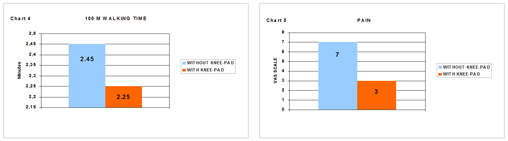
The 100 meters walking test shows an improvement of the capacity of dynamic walking. Patients using the variable rotation centre knee-pad show an average reduction in 100 m walking time from 2:45 to 2:25 minutes.
According to VAS scale (Chart 5), pain evaluated before using the knee-pad and a month after its use, outlines a distinctive decrease of the pain symptom with the average VAS grade dropping from 7 to 3.
Can a variable rotation centre knee-pad favour the recovery of a good autonomy level in ADL?
Resources and Methods: This testing began in January 2010. Subjects are represented by 20 patients (11 female and 9 male) who underwent surgery of hip or knee arthroprosthesis, who were carriers of gonarthrosis homo-or contralateral. 11 were female and 9 were male.
Minimum age of subjects 65 years, maximum age of subjects 86 years, average age of subjects 76 years. The controls consist of patients who underwent the same kind of operation but without phenomena of gonarthrosis. 11 female 9 male. Minimum age of subjects 67 years, maximum age of subjects 84 years, average age of subjects 77 years.
Subjects were given a variable rotation centre knee-pad, a device designed to follow the fascial and ligamentous structures of the knee.
The two groups were controlled through the WOMAC osteoarthritis index both in terms of level of autonomy in ADL when admitted to our department and on months 1 and 3.
Patients with gonarthrosis using the knee-pad were also evaluated on a stabilometric platform through the Static Test Riva in order to define the oscillation of the body axis and to evaluate the usage time of hands in a precautionary support position. They were also evaluated with the 100 m Walking Test for comparing the travel time of 100 m with and without knee-pad., and finally the pain symptom was avaluated through the VAS scale before and after the application of the knee-pad.
Results: Subjects evaluated so far show have shown a level of autonomy in ADL overlapable to patients without osteoarthritis after the use of the knee-pad.
This can be seen in the chart.
Please remember that higher WOMAC grade correspond to worse clinical conditions.
The assessment of the balance through the stabilometric platform through the Static Test Riva demonstrates that the use of a variable rotation centre knee-pad determines a reduction of the swing in monopodalic support thereby reducing the risk of falling.
As seen in chart 2 the average oscillation of the body axis during monopodalic support passes from 3,0° to 2,4 ° and it decreases its precautionary resting time (see chart 3) from 82,2% to 60,7% in patients using the knee-pad.
The 100 meters walking test shows an improvement of the capacity of dynamic walking. Patients using the variable rotation centre knee-pad show an average reduction in 100 m walking time from 2:45 to 2:25 minutes.
According to VAS scale (Chart 5), pain evaluated before using the knee-pad and a month after its use, outlines a distinctive decrease of the pain symptom with the average VAS grade dropping from 7 to 3.

Conclusions: The employment of a variable rotation centre knee-pad should be one of the main treatments in the management managing of gonarthrosis. Our result confirms the ipotesis assumption that a variable rotation centre knee-pad favours the recovery of a good good quality autonomy level in ADL without exert causing unnecessary stress on the fascial and ligamentous structures.
The variable rotation centre knee-pad also determines a prompt and immediate pain reduction and improved balance and gait thereby reducing the risk of downfalls.
The variable rotation centre knee-pad also determines a prompt and immediate pain reduction and improved balance and gait thereby reducing the risk of downfalls.
