
| articolo-therema-eng.pdf |
Pellis G.
Variable center of rotation concerning the physiological motion of the knee theorem
XIX Convegno di Traumatologia e Riabilitazione Sportiva, Bologna, 2010, Calzetti Editore, Perugia
Declaration
Given the natural flexion/extension movement of the knee as a combination of rolling and sliding during the first 30° of flexion; subsequently the real flexion depends upon the position of the center of rotation.
This implies that there is a difference between the knee angle measured with a goniometric sytem and the real distance between the foot and the axis of rotation.
Hypothesis
After an initial circular rotating phase, the flexion/extension movement of the knee proceeds with a combination of rolling and sliding (rotary - traslational) motion, which is characterized by the progressive decrease of the distance between the starting rotation and the articular surface.
Thesis
The knee flexion/extension axis achieved after a rolling and sliding motion, is different from the axis measured only with a protractor; thus a correct evaluation of the flexion/extension motion of the knee should consider the instantaneous displacement of center of rotation.
Proof
The position of the instantaneous center of rotation of the knee is initially placed on the x axis as an extension of the longitudinal axis of the thigh, whereas during the full extension of the thigh, it overlaps the longitudinal axis x of the leg itself. In this case the initial center of rotation of the knee coincides with the origin of Cartesian coordinate system xOy.
Variable center of rotation concerning the physiological motion of the knee theorem
XIX Convegno di Traumatologia e Riabilitazione Sportiva, Bologna, 2010, Calzetti Editore, Perugia
Declaration
Given the natural flexion/extension movement of the knee as a combination of rolling and sliding during the first 30° of flexion; subsequently the real flexion depends upon the position of the center of rotation.
This implies that there is a difference between the knee angle measured with a goniometric sytem and the real distance between the foot and the axis of rotation.
Hypothesis
After an initial circular rotating phase, the flexion/extension movement of the knee proceeds with a combination of rolling and sliding (rotary - traslational) motion, which is characterized by the progressive decrease of the distance between the starting rotation and the articular surface.
Thesis
The knee flexion/extension axis achieved after a rolling and sliding motion, is different from the axis measured only with a protractor; thus a correct evaluation of the flexion/extension motion of the knee should consider the instantaneous displacement of center of rotation.
Proof
The position of the instantaneous center of rotation of the knee is initially placed on the x axis as an extension of the longitudinal axis of the thigh, whereas during the full extension of the thigh, it overlaps the longitudinal axis x of the leg itself. In this case the initial center of rotation of the knee coincides with the origin of Cartesian coordinate system xOy.
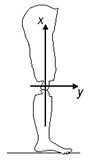
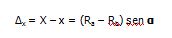
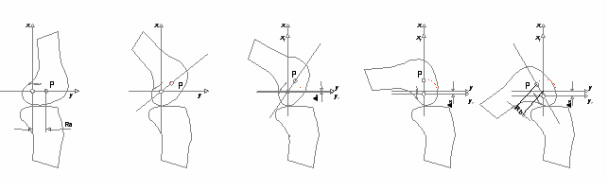
Provided that Ra is the first rotating radius that lies on the y axis, we could describe the gradual displacement of the axis of rotation of the knee, the trajectory of flexion and extension of the leg on the thigh can be analitically defined as:
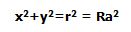
according to α <30 °, the knee motion can be described as a rigid system that rotates around a fixed center: the trajectory performed by the point P is the equation of circumference

The equation of the center of rotation of the knee appears to be:
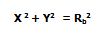
when Rb is the real (effective) radius of rotation changing with the mutation of α, when Rb < Ra.
When α is the angle between the x-axis and the radius of rotation, the values of x, X, y and Y can be obtained as:
When α is the angle between the x-axis and the radius of rotation, the values of x, X, y and Y can be obtained as:
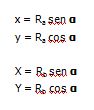
So when a given value of α is included between 30° and 135° the position of the istantaneous center of rotation can be calculated as:
Pratical application – The new scale angle
As seen from above, it appears that the rolling and sliding motion the peripheral point P follows a curve with a spiral process, receding toward the center.
This implies that the scale for the evaluation of the actual angle of the knee must be established by the sequence of extreme points P of radius Ra, which second end (it initially overlaps with the origin of the reference xOy system) after 30° it moves along the x axis within a degree equal to ∆x
Therefore the angular reference information on the spiral curve (Fig. 1) must be placed according to the new source xO'Y as a result of the instantaneus shift of the goniometric system along the x axis, when O'= O + ∆x, as a new instantaneus center of rotation.
As seen from above, it appears that the rolling and sliding motion the peripheral point P follows a curve with a spiral process, receding toward the center.
This implies that the scale for the evaluation of the actual angle of the knee must be established by the sequence of extreme points P of radius Ra, which second end (it initially overlaps with the origin of the reference xOy system) after 30° it moves along the x axis within a degree equal to ∆x
Therefore the angular reference information on the spiral curve (Fig. 1) must be placed according to the new source xO'Y as a result of the instantaneus shift of the goniometric system along the x axis, when O'= O + ∆x, as a new instantaneus center of rotation.
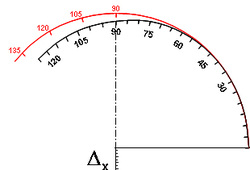
Angular scale concerning Ra= 13mm and ∆x= 3,6mm
