ktj research
  • home
  • Products
    • KTJ4 braces >
      • characteristics of the joint
    • mono-articolar tutor
    • bi-articolar tutor
    • tri-articular tutor
    • Download 3D model STL
  • theory
    • knee motion >
      • opposite theory
      • anatomical compatibility
      • mechanical stresses
      • center of the knee
      • rebound
      • discharge of the rebound
    • biomechanical study >
      • knee/machine alignment
      • roto-traslatory motion
      • knee theorem
      • correction factor
      • roto-traslational evaluator
      • biomechanical testing >
        • comparison
        • tension
    • mechanical device >
      • state of the art >
        • pathes for comparison
        • fixed center joint
        • Patent US 4 643 176 A1 - Don Joy
        • Patent EPT 0361 405 - Townsend
        • PCT WO 92/15264 Townsend
        • US 6059743 - Bauerfeind
        • PCT WO 2004/078078 A1 - FGP Physioglide®
        • other
      • self-centering
      • technical data KTJ
    • human studies >
      • comfort
      • classification of exercises
      • passive motion device
      • KTJ tutor
  • corner KTJ / service
    • protected load >
      • cartilage biomechanics >
        • organic adaptation
        • mechanical protection
      • deambulatory recovery
      • running recovery
    • a program for you >
      • request your password
      • how to fill the request form
      • request form walking programs
      • request form running programs
    • corner for your gym >
      • software Top7-KTJ
      • deambulatory / running >
        • price list
  • reference
    • award
    • bibliography KTJ
    • download PDF
    • curriculum
  • ITALIANO

discharge of the rebound

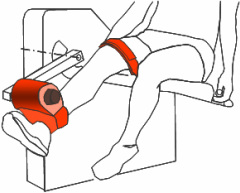
To avoid that stress of "rebound" are discharged within the knee, It  is essential to anchor all the lower limb to the machine (the thigh to the seat and the leg to the movable arm) so that this "damaging" stresses are absorbed by the mechanical organ.

This operation, however, is not possible with current leg extension because there is a further problem related to the difference in machine / knee trajectory, also highlighted by the biobliographic analysis.
 
The movable arm moves, in fact, only with a rotary motion around a fixed center while the knee, after the 30 degrees, performs a roto-translational motion. 
 
This implies that if the leg is anchored to the movable arm, it  will drag the knee on its trajectory with fixed center.


So:
Immagine
with the leg anchored in extension, the latter during flexion will be removed from its root with great ligament suffering;
with the leg anchored in flexion, extension the latter during
extension will create a strong compression of the articular heads with severe
cartilages and meniscus pain
The resolution of the problem, therefore, must necessarily provide that  leg extension proposes a roto-translational movement of the movable arm, similar to those of the knee so that we can anchor the whole lower limb to the machine (the thigh to the seat  and the leg to the movable arm) without causing  removal situations between the articular heads and at the same time to discharge the  "rebound" on the machine structure.

Basato su tecnologia Crea il tuo sito web unico con modelli personalizzabili.